Ground Truth: Why Local Geology Should Shape Your Plaster Repairs

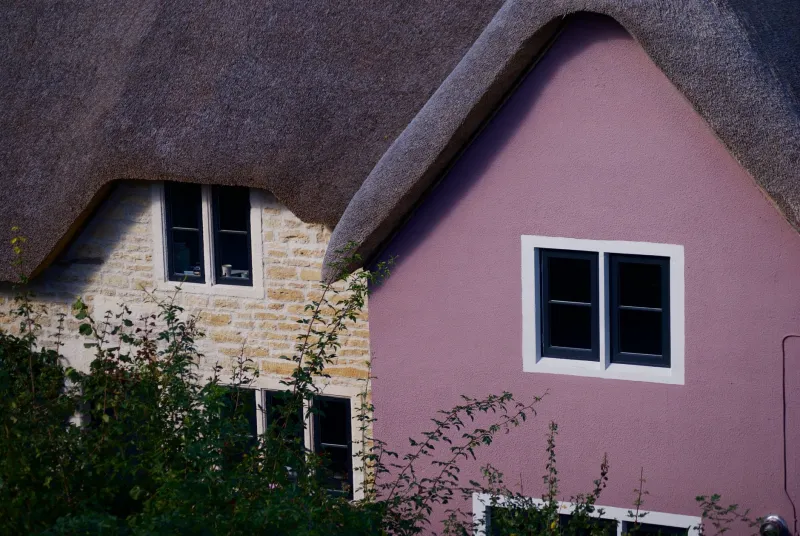
Photo: Oleg Yunakov, CC BY-SA 4.0, via Wikimedia Commons
The wall in front of you came from somewhere close
A plasterer I know in Hampshire has a habit of asking new clients one odd question before quoting: what's under the garden? Not in a mystical sense — he wants to know whether they're on chalk. If they are, he'll lean towards a chalk lime putty for internal work and a soft, locally sourced sand for the render. If they're on clay, the conversation shifts. It's a small ritual, but it captures something the modern retrofit industry often forgets: for most of British history, plaster was a local material.
Builders didn't specify products from a national catalogue. They used what was within carting distance — lime burned from local stone, sand dug from the nearest pit, clay subsoil from the field behind the village. The result is that the fabric of old British houses is regionally distinctive in ways that a generic 'breathable' specification tends to flatten out.
Chalk country: Hampshire, Sussex, Wiltshire
Where chalk lies under the soil, lime was traditionally burned from chalk rather than limestone. Chalk lime is soft, white, and slow-setting. It makes a beautifully workable putty and a gentle, flexible mortar that suits the soft brick and timber-framed walls common across the chalk belt.
On the surface, chalk lime can look deceptively simple: mix it with local sharp sand and you have a render. But chalk lime is not a high-strength material. It relies on carbonation over time and prefers shelter. On a west-facing Wiltshire wall taking driving rain, a straight chalk lime render may need more frequent attention than a modestly hydraulic alternative — not because it's 'wrong', but because the exposure is different from the sheltered internal walls it was originally developed for.
The lesson for repair is straightforward: a chalk lime putty is often the right match for internal plaster on lath, but external work may call for a locally appropriate blend or a carefully chosen hydraulic addition. The point isn't to romanticise softness; it's to recognise that the material grew up in a particular climate and construction tradition.
Cob and clay country: Devon, Somerset, Dorset
Head west and the ground changes. In cob country, earth — not lime — was the traditional walling and plastering material. Cob walls are thick, monolithic, and breathable by nature. Their historic plasters and renders were often clay-based, sometimes with lime wash or a lime-rich top coat for weather protection.
A common repair mistake here is to treat a cob wall like a masonry wall and smother it in cement render or a strong hydraulic lime. Both can trap moisture in the earth beneath, leading to erosion and the dreaded 'shelving' at the base. Local clay plasters, by contrast, are compatible in strength, flexibility, and moisture behaviour. They also move with the wall rather than fighting it.
Homeowners in this region often ask whether clay plaster is 'as good as' lime. It's the wrong question. A locally sourced clay plaster on a cob wall is doing a different job from a lime render on a chalk wall. Matching the material to the substrate matters more than choosing between two broad categories.
Clunch and chalk block: Cambridgeshire, Norfolk, Suffolk
In parts of East Anglia, the local building stone is clunch — a soft chalk block used in churches, houses, and boundary walls. Clunch is famously vulnerable to weather, and historic plasters around it tended to be soft and sacrificial. Lime made from chalk was often paired with local sands to create a render that would erode slowly rather than trap water against the stone.
Repairing clunch walls with modern hard renders is a well-known route to trouble. The render may look smart for a few years, but it can force moisture into the clunch beneath, leading to flaking and loss of the stone face. Local lime mixes — sometimes with a modest hydraulic content for exposed elevations — are usually the safer bet, provided the sand is well graded and the detailing lets water out.
The sand matters as much as the binder
Plasterers talk a lot about lime, but sand is the quiet majority of any mix. Local sands vary enormously: some are sharp and gritty, some contain silt or clay, some are rounded river sands. That variation affects workability, permeability, and the way a render dries.
A chalk lime mixed with a soft, fine local sand behaves differently from the same lime mixed with a washed, coarse grit. Neither is universally 'better'. The question is what suits the wall, the exposure, and the finish. Historic plasters often relied on sands that were less uniform than modern bagged products, and that irregularity contributed to their performance.
What neighbouring buildings can tell you
Before ordering anything, look around. Old churches, boundary walls, outbuildings, and earlier repairs on the same street are a free field guide. Note the colour, texture, and erosion patterns. A soft, sandy render that has weathered gracefully for decades is telling you something useful. A hard patch that has cracked and detached is telling you something too.
Local lime suppliers and conservation officers are often the best sources of place-specific knowledge. They know which quarries still produce suitable sand, which limes are used on local churches, and where previous repairs have failed. A short conversation can save a lot of trial and error.
Matching place over generic specifications
'Breathable' is a property, not a product. A specification that says 'breathable lime render' without naming the binder, the sand, the substrate, and the exposure is only half a specification. On a soft chalk wall in a sheltered courtyard, a weak local lime may be ideal. On an exposed coastal elevation, the same mix might need help from better detailing, a modest hydraulic component, or a different finish.
The point is not to reject modern materials or insist on some purist local-only rule. It's to recognise that old buildings were built from the ground up — quite literally — and that repairs often work best when they respect that logic. The best plaster for your house might not be the most technically advanced product on the merchant's shelf. It may be the one that came from a quarry down the road, chosen because it suits the wall it's protecting.