Oak That Moves, Plaster That Copes: Detailing Lime and Clay Around Historic Beams
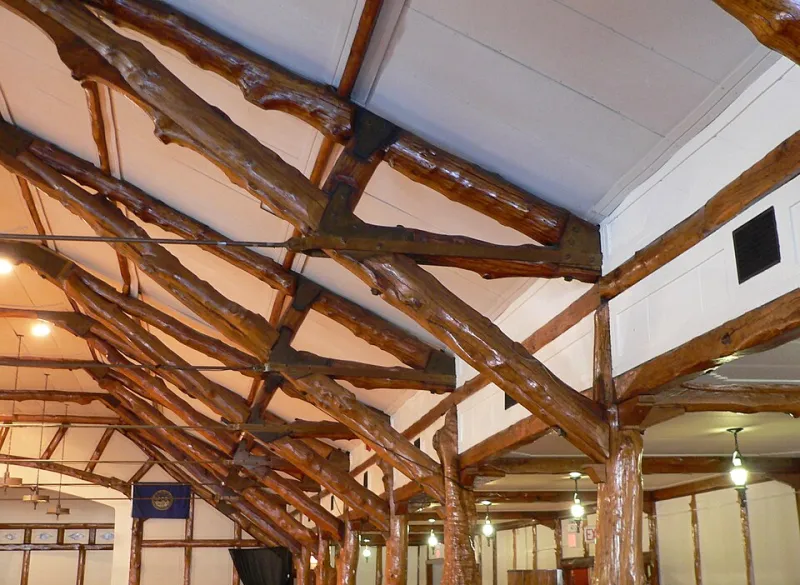
Photo: Ammodramus, Public domain, via Wikimedia Commons
The Suffolk farmhouse had the kind of frame that makes a plasterer put the kettle on and think. A spine of old oak, bays out of square, and infill panels that had been patched with cement, gypsum and hope over several centuries. The owner wanted the beams left exposed and the walls finished in lime and clay. The catch was the movement. Oak is not a static background. It swells and shrinks across the grain with the seasons, and every one of those small movements lands at the junction between timber and plaster.
The project ran in 2026. The lessons are old.
Why oak and plaster fall out
Oak moves mostly across the grain, not along it. A beam can change width through the year while its length stays comparatively stable. Old oak moves less dramatically than green oak, but it still moves. The plaster around it is asked to stay put. If the finish is rigid and bonded hard to both the beam and the masonry, the stress has nowhere to go. Cracks appear at the arris, usually as a fine line that opens in spring and closes in autumn.
Lime and clay are more forgiving than gypsum, but they are not immune. A lime plaster can accommodate some movement through its lower stiffness and its pore structure. Clay is softer and often more flexible in small sections. Neither will forgive a detail that traps them.
Read the frame before you mix
Before any backing coat goes on, spend time with the timber. Tap for hollow sections and check for beetle, rot and previous repairs. Look at how the beam is supported and whether it has dropped. A crack at a beam junction may be a plaster problem, but it may also be a structural one. Photograph and draw the frame. Note the chamfers, the old mortices and the uneven faces. These details decide where a bead can sit and where a movement joint is needed.
Check the infill. Old wattle and daub, brick nogging and later blockwork all behave differently. Remove loose material, but do not assume every dark patch is death. Some old daub is sound and useful.
Keying and background
Keying is not just scratch. It is the route by which the plaster grips and the route by which moisture moves. On lath, check the spacing and fix loose laths. On masonry, control suction and dub out before the first coat. A scratch coat should be pressed into the key, not floated flat. If the background is very uneven, build out in lifts rather than one thick pack.
Around beams, keep the plaster independent where it meets the timber. A hard, continuous bond to a moving beam is an invitation to a crack.
Mesh and bead details
Use alkali-resistant mesh or stainless steel mesh at junctions, embedded in the plaster across the beam and into the field. Do not staple mesh tight to the oak and then bury it. The mesh should reinforce the plaster, not tie it rigidly to the timber. Fix beads to the masonry, not rigidly to the beam, and leave a small gap where movement is expected. A flexible, vapour-open sealant or a lime mortar fillet can close the gap without locking it.
On the Suffolk job, we used a shadow gap at two internal beams and a fine lime fillet at the external wall junctions. The shadow gap looked deliberate and gave the oak room to move. The fillet was less visible but needed regular checking during curing.
Lime or clay around beams?
Lime is the safer choice where damp, external walls or high humidity are involved. It is vapour open, capillary active and compatible with old masonry. Clay is excellent on dry internal panels, where its lower stiffness and humidity-buffering behaviour can help. Around beams, clay can be more forgiving, but it is softer and less resistant to water. Do not use clay where it will sit wet.
The specification matters more than the label. A well-detailed lime system will outperform a badly detailed clay one, and the reverse is also true.
Repair strategies
When a junction has failed, rake out the loose material and find the cause. If the beam has moved, a cosmetic fill will fail again. Re-key the edges, dampen the background and apply the repair in thin lifts. Use mesh where the repair crosses the junction. Do not fill a deep gap in one go. A repair that looks neat today but is too strong and too rigid will crack next season.
Finish choices
Keep the finish breathable. Limewash, clay paint and mineral paints are the usual choices. Avoid vinyl emulsions and sealed primers over new lime or clay. A slight texture helps hide small movements, and a matt finish is more forgiving than a sheen. Where the beam is very irregular, a chamfer or a simple fillet looks more honest than a perfect bead.
Lessons from the Suffolk job
- Read the frame before specifying the plaster.
- Isolate the plaster from the beam where movement is likely.
- Use mesh to reinforce, not to tie.
- Build out in lifts and control suction.
- Choose lime or clay for the wall conditions, not the fashion.
- Leave a detail that can be maintained.
The farmhouse will keep moving. That is what oak does. The plaster’s job is not to stop it. It is to move enough, and gracefully enough, that the wall stays sound.